Is your hospital’s emergency communication system keeping pace?
Audio paging remains essential, but audio alone may not reach every patient, visitor and staff member. Noisy areas, hearing limitations, complex campuses, disconnected systems and infrastructure can all create communication gaps when clarity matters most.
Free self-assessment • no obligation
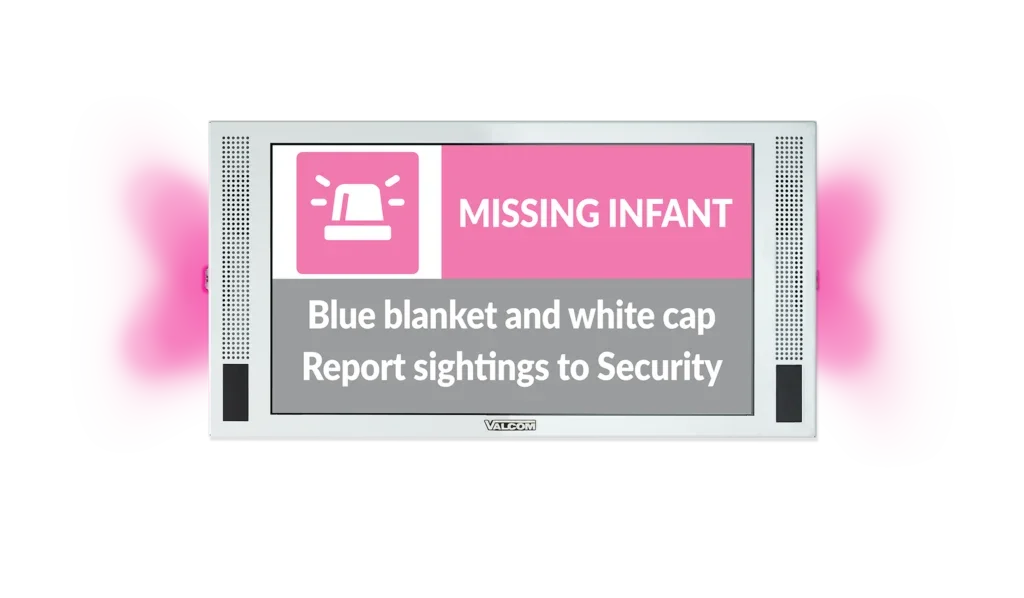
Overhead audio • Visual display • Desktop & mobile
One plain-language message.
Seen, heard and understood everywhere it’s needed.
Request a Healthcare Communication Readiness Assessment
Meet with a Valcom healthcare expert to evaluate your current emergency communication capabilities and identify priorities for a phased improvement plan.
- Review communication coverage across your facilities
- Identify gaps in audio, visual, zoning, and plain language messaging
- Evaluate staff safety, system integrations, and endpoint visibility
- Prioritize immediate needs and long-term improvements
- Begin a phased, five-year communication roadmap
• THE COVERAGE QUESTION
Five questions your current system needs to answer
Most hospitals already have an emergency communication system. A modern plan means checking whether it can still do the following.
| ✔️ Can your system reach staff, patients and visitors through both audio and visual channels? |
| ✔️ Does your system provide clarity that delivers clear, actionable instructions using plain language where appropriate? |
| ✔️ Can your system route messages to the right departments, zones, buildings, and outdoor areas? |
| ✔️ Can your system integrate with clinical, security, access control, cameras, radios, and duress systems? |
| ✔️ Does your system provide visibility to monitor communication endpoints and catch issues before they become disruptions? |
• How can hospitals reduce noise without missing important messages?
Why Quiet Hospitals Matter?
Every page that goes out to the whole building reaches patients who don’t need it, staff who tune it out, and families trying to rest. Over time, that noise hurts patient experience, adds to communication fatigue, and makes it harder for the messages that matter to get through.
But turning paging down isn’t a real option either. Your teams still need to coordinate in real time, and your facility still has to respond instantly when a code is called.
The answer is to be precise: send the right message to the right people in the right place, and nowhere else.
• Would visitors, patients and travel staff know what your alerts are?
Plain Language Protocol
Plain-language communication, used in accordance with the hospital’s emergency protocols, can make instructions clearer and more actionable. Reinforcing audio with visual messaging also helps reach people who may not hear or understand an overhead announcement.
“Valcom helps healthcare facilities ensure critical messages are seen, heard and clearly understood – while reducing communication noise, service disruptions and the burden of maintaining legacy systems.”
– Valcom Healthcare Team
• WHY VALCOM
Built for healthcare
V-Guardian Alert
Wearable staff duress badges with location awareness link directly to your speakers, displays, radios, cameras, access control, and nurse-call workflows
Audio + Visual
Plain language instructions reinforced with visual displays reach people who may not hear or process an overhead announcement – in every zone, indoors and out.
IP EndPoint Visibility
Monitor device status from a central location, troubleshooting remotely, and reduce unnecessary exploratory work in controlled clinical environments.
One Platform
Clinical, security, access control, camera, radio, and duress systems – centrally managed, so messages route to the right place automatically.